

img
  • Professional Services
  • Physical
  • 2 hours ago
  • 2 views

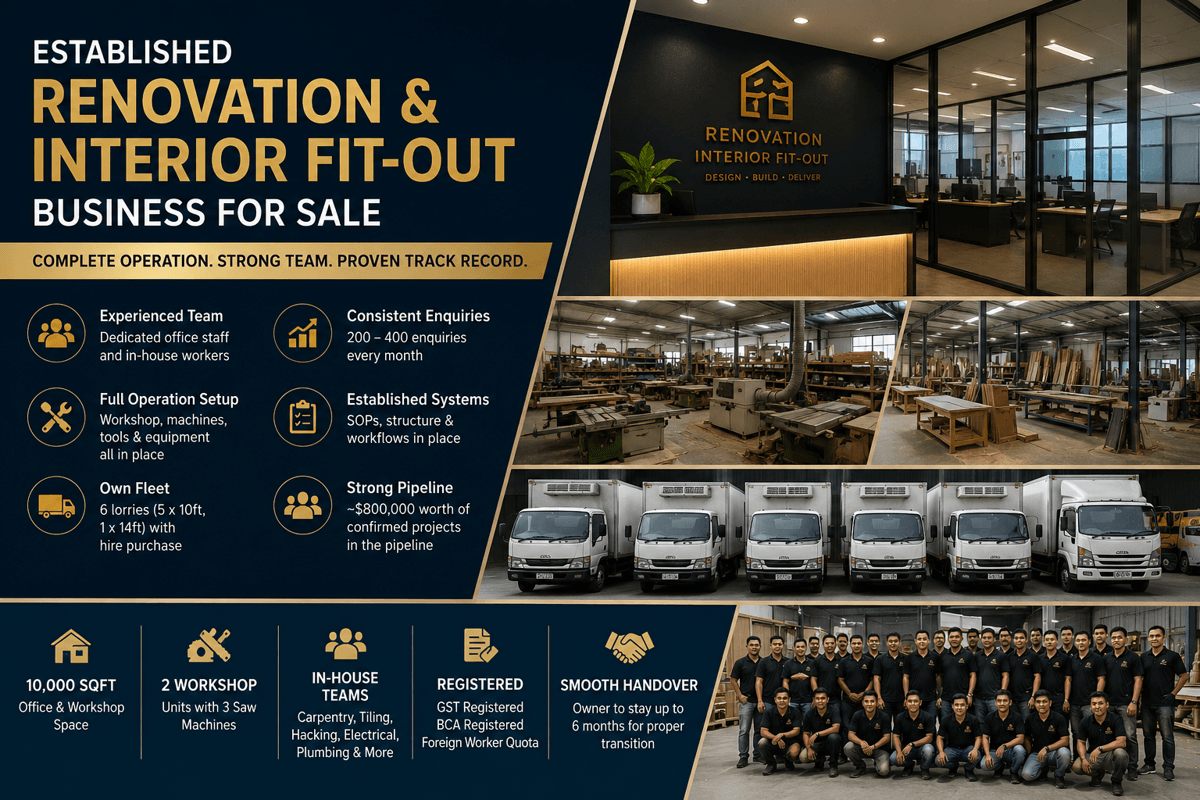
Singapore Interior Works Contractor With Lorry Fleet

Basic Business Information

  • Industry: Professional Services
    • Legal Structure: Mostly one-off transactions
    • Operating Model: Physical
    • Year Founded: 1990
    • Team Size: 1
  • Reasons for Selling:

    Owner looking to spend more time with family

  • Description

    Financial Information

    Currency: SGD (S$)
    Financial Trends
    Annual Revenue Overview
    Financial Summary (SGD)
    Revenue (Dark Purple)
    Profit (Light Purple)
    3-Year Financial Summary
    Year Revenue (SGD) Earnings (SDE) NET MARGIN
    2025 SGD 7M SGD 700K 10.0%
    MONTHLY OPERATING COSTS
    Not Disclosed
    MONTHLY MISC. EXPENSES
    Not Disclosed
    BUSINESS MODEL
    Revenue Model: Mostly one-off transactions
    Tangible Assets:
    • Real estate: S$30,000

    • Vehicles: S$600,000

    Intangible Assets:
    • N/A

    Other Details

  • Licenses & Permits:

    N/A

  • Support Provided:
    • Staff Support: Team: HR, admin, finance, marketing, sales consultants, site coordinators, supervisors, foreign workers

    SWOT Analysis

    AI paraphrased description: This SWOT analysis helps you quickly see the good and bad sides of a business, plus the opportunities to grow it and the risks to watch out for. It makes it easier for buyers to decide if a business is worth buying without getting lost in complicated details

  • Seller-reported profitability at typical contractor margin range
  • Seller-submitted figures indicate SGD 7.0m revenue and SGD 0.7m SDE in 2025, implying an approximate 10% margin. For Singapore interior fit-out / renovation contractors, net margins are often in the ~5–12% range depending on subcontracting, project complexity, and variation orders; if verified, this suggests the business is operating within a viable profitability band for its segment. A buyer would be acquiring an earnings base that could support financing and working-capital needs, subject to confirming cost allocation (materials, subcontractors, labour) and cash conversion.

  • Operational mobility supported by a seller-reported lorry fleet
  • The listing states 6 company lorries are included, valued by the seller at SGD 600k. For interior works businesses in Singapore, owning vehicles can reduce dependence on third-party logistics and improve responsiveness across multiple sites, which is a practical execution advantage versus starting from scratch with rental-only arrangements. If ownership, COE status, utilization rates, and maintenance records hold under due diligence, the fleet can represent meaningful replacement-cost value and day-one operational continuity.

  • Physical setup suggests capacity for storage and staging of works
  • The seller reports security deposits (SGD 30k) tied to two factory units plus a worker dormitory arrangement. For a contracting operation, having established premises can support storage of materials/tools and staging, which reduces friction in project delivery compared with a new entrant that must secure industrial space and approvals. In Singapore, comparable industrial leases typically require deposits of ~2–3 months’ rent plus reinstatement obligations; if the leases are transferable and terms are favourable, this supports continuity and reduces setup time post-acquisition.

  • Scale of reported revenue implies established project sourcing
  • The business reports SGD 7.0m annual revenue on a mostly one-off project model. In Singapore, many small renovation/interior contractors operate at materially lower annual turnover (often sub-SGD 1–3m unless they have strong subcontract networks or repeat commercial clients); at this reported level, the operation likely has functioning lead sources, project management routines, and supplier/subcontractor relationships that a buyer would otherwise need time to build. This acquisition value depends on verifying client concentration, repeat-customer rate, and whether pipeline is tied primarily to the owner’s personal relationships.

  • High key-person dependency implied by one-person team size
  • The listing states a team size of 1, which implies the owner may be central to sales, quotations, site supervision, and subcontractor coordination. For Singapore renovation/interior works, comparable firms doing multi-million revenue typically require multiple roles (project manager/site supervisor, admin/procurement, safety coordination) whether in-house or outsourced; a one-person structure increases execution and continuity risk on day one for a buyer. A buyer would need a clear handover plan and evidence of stable subcontractor availability to avoid delivery disruption.

  • Project-heavy, one-off revenue model reduces cashflow predictability
  • The revenue model is described as mostly one-off transactions, which is common in Singapore renovation contracting but results in lumpy collections and higher working-capital swings (deposits, progress claims, retention sums). Compared with businesses with maintenance contracts or term service agreements, a project-only mix typically carries greater month-to-month revenue volatility and higher exposure to delayed payments. A buyer inherits the need to actively manage pipeline, progress billing discipline, and accounts receivable aging from day one.

  • Financial verification gap: single-year figures with no cost structure
  • Only 2025 revenue and earnings are provided, with no multi-year trend, no breakdown of direct costs (materials/subcontractors), and no disclosure of debt or working-capital position. In Singapore contracting businesses, profitability can vary materially year to year based on a few large projects and variation orders; buyers typically underwrite on 3-year normalized earnings plus pipeline/backlog. A buyer should treat the stated SDE as indicative until reconciled to IRAS filings, bank statements, and project-level gross margin reports.

  • Sole proprietorship increases transfer complexity for buyer
  • The business is a sole proprietorship, which in Singapore commonly means the transaction is structured as an asset purchase rather than a clean share transfer. Relative to acquiring a company with assignable contracts and established employment structures, an asset deal can require re-papering customer contracts, supplier accounts, rentals/leases, and potentially reapplying for certain registrations where applicable. This adds time and legal/admin cost that a buyer inherits as part of execution.

  • Limited independently visible brand and lead-generation footprint
  • No website, social channels, or Google Business Profile data is provided in the listing, leaving limited independent evidence of market presence or reputation. For Singapore renovation/interior services, peers commonly use portfolios, Google reviews, and social proof to convert leads; absence can constrain growth and make sales more reliant on referrals and the owner’s network. A buyer may need to invest early in a basic digital presence and portfolio documentation to maintain lead flow post-transition.

  • Introduce recurring maintenance/defects-liability packages
  • Within the first 6–12 months, a buyer could convert a portion of completed-project clients into recurring revenue by offering scheduled maintenance, minor works retainers, and defects-liability response packages with clear SLAs and monthly fees. This is achievable using existing delivery capability (vehicles, onsite response) without major capex, provided client lists, warranty/defects obligations, and contact permissions are properly documented at handover. Even modest retainer penetration can reduce the cashflow volatility inherent in one-off renovation projects and improve valuation multiples.

  • Professionalise tendering and margin control through job costing
  • In the first 90–180 days, a new owner can implement standardized quotation templates, variation-order controls, and job-costing (project P&L by site) to systematically protect gross margins. Singapore interior works margins are often eroded by scope creep and delayed variation claims; putting process around approvals and progress billing is a practical lever that does not require expanding headcount immediately. This depends on having access to historical project files and supplier/subcontractor invoices to build reliable costing benchmarks.

  • Build a portfolio-led digital funnel to reduce referral dependence
  • Over 6–12 months, the buyer can create a basic website and project portfolio (before/after case studies, certifications, safety practices, and capability scope) and run targeted Google/Meta campaigns focused on specific job types the business already executes. In Singapore, many renovation decisions are shortlist-driven based on visible proof of work; a portfolio-first approach can convert existing offline credibility into online lead flow. This is most effective once the buyer has clarified the company’s niche (residential vs commercial, reinstatement, A&A support) and can demonstrate consistent delivery capacity beyond the owner.

  • Monetise fleet capacity through scheduling and third-party hires
  • If vehicle utilisation is not already maximised, a buyer could improve returns within 6–9 months by formalising delivery schedules across sites and selectively offering transport/disposal support to partner contractors during off-peak periods. In Singapore, outsourced lorry availability and disposal logistics can become bottlenecks on tight timelines; monetising spare capacity can add ancillary revenue without changing core positioning. This requires confirming that insurance coverage, driver arrangements, and permitted usage align with any third-party work.

  • Labour policy and manpower availability can compress delivery capacity
  • Singapore renovation and interior works rely heavily on site labour availability, and manpower constraints (including permit availability, levies, and subcontractor capacity) can reduce the number of concurrent projects the business can deliver. With a seller-reported team size of 1, the company is more exposed to execution bottlenecks because it likely depends on external subcontractors and the owner’s supervision bandwidth. Even with stable demand, inability to staff sites reliably can delay completion, trigger liquidated damages/penalties, and reduce margins over the next 24 months.

  • Materials and subcontract cost volatility may erode project margins
  • Interior works projects in Singapore can be sensitive to fluctuations in material prices and specialist subcontract rates (e.g., carpentry, M&E, tiling), especially when quotations are fixed-price and variation orders are not tightly controlled. A business operating on one-off projects has limited ability to smooth these increases across a subscription base, so margin pressure can show up quickly within a year. This threat is amplified if the company lacks negotiated supplier terms or relies on a small number of subcontractors.

  • Competitive tendering by larger contractors can pressure pricing
  • The Singapore renovation/fit-out market includes many larger players that can bid aggressively due to scale purchasing and deeper project management benches, which can force smaller operators to accept thinner margins to maintain volume. A small operation with limited headcount may struggle to pursue multiple tenders concurrently or absorb long payment cycles, reducing its ability to compete on larger commercial jobs. The likely outcome within 24 months is pricing pressure unless the business differentiates by niche specialization, speed, or service reliability.

  • Post-sale transition risk if relationships are owner-led
  • In project-based contracting, repeat wins often depend on the owner’s relationships with clients, main contractors, suppliers, and site coordinators; if these ties are personal rather than contractual, revenue may soften after a change of ownership. With a single-person setup, this exposure is higher because fewer relationships are institutionalised across a team. A longer, structured handover period and documented client/contact ownership can mitigate this, but without it the business may face near-term pipeline slippage.

    DATA DISCLOSURE

    • Analysis based on self-reported data provided by seller
    • Independent verification of all claims recommended
    • Buyers should conduct comprehensive due diligence including financial audit, customer interviews, and legal review
    • Contact seller for supporting documentation (tax returns, contracts, licenses, etc.)

    Asking Price:

    S$5,000,000

    2.5 / 5

    Preferred Contact

    Email

    Location:

    Geylang

    Revenue:

    S$7,000,000

    Profit:

    S$700,000

    Contact

    Please wait while we prepare your results

    Checking the data and setting up the next view. Please stay on this page while we finish loading. Almost there. Your content will appear shortly.