

img
  • Beauty & Wellness
  • Physical
  • 2 hours ago
  • 1 views

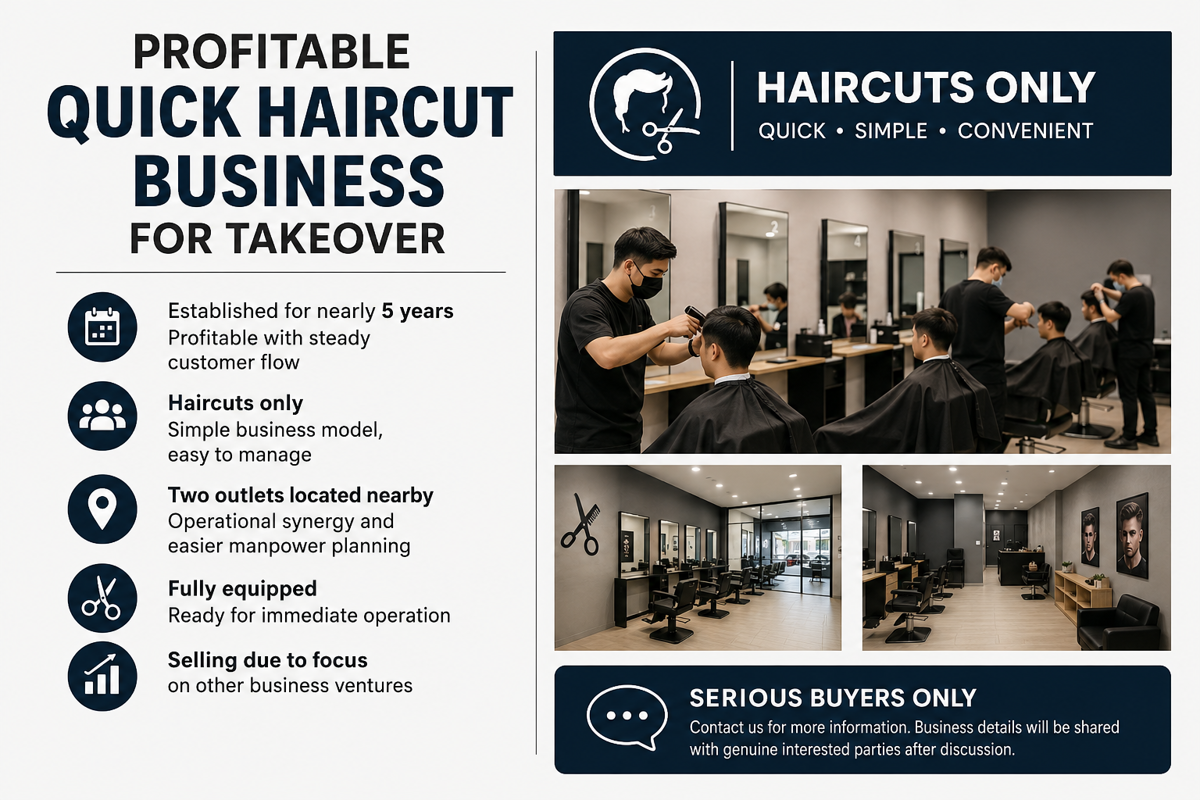
Two-outlet Quick Haircut Business Takeover In Singapore

Basic Business Information

  • Industry: Beauty & Wellness
    • Legal Structure: Mostly one-off transactions
    • Operating Model: Physical
    • Year Founded: 2021
    • Team Size: 1-5
  • Reasons for Selling:

    Focusing on other business ventures

  • Description

    Financial Information

    Currency: SGD (S$)
    Financial Trends
    Annual Revenue Overview
    Financial Summary (SGD)
    Revenue (Dark Purple)
    Profit (Light Purple)
    3-Year Financial Summary
    Year Revenue (SGD) Earnings (SDE) NET MARGIN
    2025 SGD 50K SGD 10K 20.0%
    MONTHLY OPERATING COSTS
    Not Disclosed
    MONTHLY MISC. EXPENSES
    Not Disclosed
    BUSINESS MODEL
    Revenue Model: Mostly one-off transactions
    Tangible Assets:
    • N/A

    Intangible Assets:
    • N/A

    Other Details

  • Licenses & Permits:

    N/A

  • Support Provided:
    • N/A

    SWOT Analysis

    AI paraphrased description: This SWOT analysis helps you quickly see the good and bad sides of a business, plus the opportunities to grow it and the risks to watch out for. It makes it easier for buyers to decide if a business is worth buying without getting lost in complicated details

  • Simplified haircut-only operating model
  • The company operates a haircut-only service model (no washing, colouring, or chemical treatments), which reduces consumables, service variability, and training time relative to full-service salons. In Singapore, full-service salons typically carry broader product inventory and longer service times, which increases working capital needs and scheduling complexity; a quick-cut model can run with leaner processes. This can allow a buyer to stabilise operations faster post-takeover, provided staffing and queue management are in place.

    Because the service scope is narrow, standard operating procedures and quality control can be more repeatable across outlets than multi-service salons, improving scalability if the buyer wants to add more units later.

  • Two physical outlets already fitted out
  • The seller reports both outlets are fully equipped and ready for immediate operation, which avoids the typical fit-out lead time and upfront capex for a new salon in Singapore. For small salon units, fit-out and equipment can commonly run from tens of thousands of SGD depending on condition and landlord requirements; acquiring an operating setup can be economically preferable if assets are in good working order. A buyer also inherits operational learnings tied to the sites (peak hours, local customer mix), which a new entrant would need time to discover.

    This strength is contingent on an asset list, condition assessment, and confirmation that equipment is owned (not leased) and transferable.

  • Seller-reported profitability at small scale
  • Seller-submitted 2025 figures indicate SGD 50k annual revenue and SGD 10k SDE, implying ~20% net margin. For Singapore small-format haircut businesses, net margins are often roughly in the 10–25% band depending on rent, manpower cost, and operating hours; if verified, this sits within a reasonable range for the segment. If the margin holds under due diligence, it supports the case that the operation can cover fixed costs and still produce owner earnings at this scale.

    As only one year of figures is provided and monthly cost breakdowns are absent, the buyer would need to validate the earnings bridge (rent, wages, CPF, merchant fees) before relying on this as valuation support.

  • Potential roster flexibility from nearby outlets
  • The listing states one outlet is near the other, enabling shared staffing and scheduling across locations. In Singapore’s hair services market, manpower is often the binding constraint (especially for experienced cutters), so the ability to shift staff between outlets can reduce downtime from leave and smooth peak-hour demand. This can be a practical advantage over a single-outlet operator, assuming both leases allow consistent operating hours and the customer base accepts occasional staff rotation.

  • One-off transaction revenue profile limits predictability
  • The seller reports revenue is driven mostly by one-off walk-in haircuts rather than memberships or contracted arrangements. In Singapore, quick-cut operators commonly face demand fluctuations tied to weekends, school terms, and nearby tenant changes; without prepaid packages or memberships, cashflow visibility is typically lower than in appointment-based salons. A buyer inherits the need to manage staffing tightly to footfall and may experience earnings volatility during the handover period if repeat-rate is lower than implied.

    This can be mitigated, but it is not optional to address because manpower scheduling and rent commitments are fixed while demand is variable.

  • Limited financial disclosure beyond a single year
  • Only 2025 revenue (SGD 50k) and SDE (SGD 10k) were provided, with no monthly operating cost, variable expense, rent, wages, or owner add-backs breakdown. For small Singapore personal services businesses, valuation and sustainability depend heavily on rent-to-sales and manpower-to-sales ratios; without these line items, profitability quality cannot be assessed. A buyer inherits the work of reconstructing unit economics for each outlet (rent, utilities, wages/CPF, merchant fees) before committing to a price.

    Given the small absolute profit quantum, even modest underestimation of rent or wages can materially change the investment case.

  • Sole proprietorship structure constrains deal mechanics
  • The business is a sole proprietorship, which in Singapore typically means the buyer will structure the acquisition as an asset purchase rather than a straightforward equity transfer. This can add administrative work (novation of leases, vendor accounts, telco/merchant facilities) and increases the importance of documenting what exactly is being transferred (equipment, brand assets, customer databases, phone numbers). For small outlets, these transfer frictions can be a meaningful portion of the transaction effort relative to deal size.

    A buyer should also confirm any licences, permits, and tenancy approvals can be re-issued or assigned to the acquiring entity without operational downtime.

  • No verifiable reputation signals provided for a walk-in consumer service
  • Google rating/review count and customer feedback themes were not provided, and no social channels were listed. In Singapore, consumer walk-in services often rely heavily on Google Maps discovery and review volume; businesses with 30–100 reviews typically convert more reliably than those with little or no public feedback. Without verified reputation data, a buyer cannot assess service consistency, wait-time management, or recurring complaints (e.g., uneven quality between cutters), all of which directly affect repeat rates.

    This gap is operationally material because the model depends on footfall and repeat customers rather than contracted revenue.

  • Introduce simple membership or package mechanics to lift repeat rate
  • Within 3–6 months, a new owner could add a low-friction membership or multi-cut package (e.g., prepaid bundles or family passes) that fits the haircut-only model without expanding into complex services. The implementation can be operationally light—QR code sign-ups, stamp cards, or POS-based tracking—and designed to reduce cashflow volatility from the seller-reported one-off transaction mix. This is most achievable if the buyer first confirms baseline footfall and repeat customer patterns by reviewing daily sales logs and peak-hour utilisation per outlet.

    If executed well, the upside is higher customer lifetime value without materially increasing service time per customer.

  • Build minimum viable digital presence for discovery and queue communication
  • In the first 90 days, the buyer can set up and standardise Google Business Profiles (if not already optimised), WhatsApp contact, and a basic Instagram/Facebook page to publish pricing, operating hours, and queue/wait-time updates. For Singapore consumer services, these channels often act as primary discovery and trust signals; even modest review volume and photo updates can improve conversion versus having no visible presence. This is achievable without heavy capex, but it requires that the buyer has control of the business phone numbers, signage permissions, and brand naming rights post-transfer.

  • Pricing and throughput optimisation using peak/off-peak mechanics
  • Within 6–12 months, the buyer could implement peak/off-peak pricing, express lanes, or time-based promotions to increase chair utilisation while protecting margins. Quick-cut operators in Singapore often compete on price, but a structured approach (e.g., weekday discounts to fill trough periods, small premium for peak slots) can improve revenue per staffed hour without adding new service lines. This is realistic if the buyer first measures daily haircut counts, average ticket size, and cutter productivity per outlet to avoid changes that create queue dissatisfaction.

  • Clarify and professionalise the two-outlet operating playbook for scaling
  • Over 9–18 months, a new owner can document SOPs for hygiene, cutting standards, cash handling, and roster planning across both outlets, turning the current setup into a replicable micro-chain template. In Singapore, multi-outlet consistency is a key differentiator versus single-operator shops, especially when staff rotate; a documented playbook reduces quality variance and makes future hiring easier. This opportunity is achievable if the seller provides a structured handover and the buyer invests early in training and basic QA checks rather than adding new services.

  • Rising manpower costs and tightening labour supply for cutters
  • The operation’s capacity is directly tied to having competent cutters on shift; with a small reported team (1–5 across two outlets), any wage inflation or attrition has an immediate impact on opening hours and revenue. In Singapore, salary expectations for experienced hairdressers and the broader competition for service staff can compress margins if pricing cannot be raised accordingly. This threat is particularly acute for a haircut-only model because there is limited room to offset wage increases with higher-ticket services.

  • Lease renewal and rent escalation risk across two premises
  • With two physical outlets, the business is exposed to rent escalation, lease non-renewal, or changes in landlord/tenant mix that can reduce walk-in traffic. For small personal services operators in Singapore, rent is often one of the largest fixed costs; a rent step-up can materially reduce the seller-reported ~20% margin at this revenue level. The risk is amplified if either outlet is dependent on a specific anchor tenant or mall footfall pattern that can change within a 24-month window.

  • Price-based competition from nearby quick-cut chains and neighbourhood salons
  • The quick haircut segment in Singapore is crowded, and competitors can respond quickly with promotions that pull away footfall. At this scale, the company may have limited marketing budget to counter sustained discounting, and haircut-only positioning reduces differentiation options. If competitors offer similar speed with stronger brand visibility or better digital discovery (reviews/photos), the business may need to match pricing, compressing margins.

  • Footfall volatility from changes in the immediate catchment
  • Because the seller reports mostly one-off walk-in transactions, revenue can move with changes in nearby office/HDB occupancy, renovation cycles, or shifts in commuter patterns. Even if the business is well-run, external changes that reduce incidental walk-ins can lower chair utilisation quickly, and the cost base (rent and minimum staffing) adjusts more slowly. This is a 24-month threat because tenancy mixes and nearby competition can change within a single lease cycle.

    DATA DISCLOSURE

    • Analysis based on self-reported data provided by seller
    • Independent verification of all claims recommended
    • Buyers should conduct comprehensive due diligence including financial audit, customer interviews, and legal review
    • Contact seller for supporting documentation (tax returns, contracts, licenses, etc.)

    Asking Price:

    S$200,000

    2.1 / 5

    Preferred Contact

    Email

    Revenue:

    S$50,000

    Profit:

    S$10,000

    Contact

    Please wait while we prepare your results

    Checking the data and setting up the next view. Please stay on this page while we finish loading. Almost there. Your content will appear shortly.