
Buying an existing business in Singapore offers an immediate route to cash flow, established operational systems, and a recognized customer base-avoiding the high risks and time-intensive roadblocks of a startup launch. However, navigating the legal complexity, verifying statutory financial compliance, and structuring the commercial transaction under Singapore law requires a precise roadmap.
This guide provides an authoritative, step-by-step framework on how to buy a business in Singapore, moving from strategic sourcing to statutory closing at the Accounting and Corporate Regulatory Authority (ACRA).
To buy a business in Singapore, follow these eight essential steps:
The Singapore market is highly specialized. To avoid wasting resources, successful buyers lock down their criteria before viewing listings.
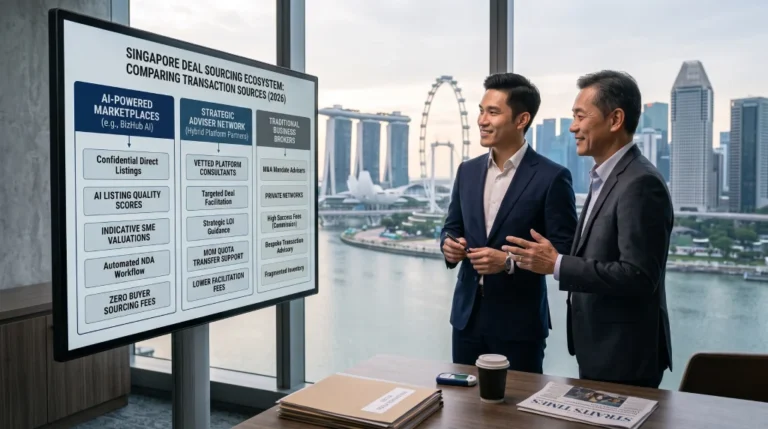
While personal networks play a role, most acquisitions in Singapore begin on digital platforms. An AI-powered marketplace provides dynamic listing summaries and performance scores that broker directories cannot match.
You can browse profitable businesses for sale by industry, location, or revenue multiples. Once an opportunity matches your investment criteria, executing a standard Non-Disclosure Agreement (NDA) grants access to the confidential deal memorandum and un-audited internal accounts (P&L and balance sheets).
Before investing in deep due diligence, you must determine if the seller’s asking price is reasonable under current Singapore market conditions. The most common valuation model for SMEs is the Earnings Multiple approach, based on Seller’s Discretionary Earnings (SDE) or EBITDA.
$SDE = Net\ Profit\ (before\ taxes)\ +\ Owner’s\ Compensation\ +\ Non-Cash\ Expenses\ +\ Non-Recurring\ Expenses$
Singapore market multiples vary significantly. As an example, a thriving hospitality or restaurant venture may trade between 1.5x and 3.0x SDE, whereas recurring-revenue B2B SaaS platforms or logistics operations routinely secure substantially higher valuation multiples.
BizHub Tip: It is crucial to utilize indicative SME valuation tools to check if a seller’s expectations match recent market transactions.
The LOI, or Memorandum of Understanding (MOU), is the critical transition from “serious searcher” to “exclusive buyer.” While usually non-binding regarding the final sale, it must contain three binding, buyer-first clauses:
In Singapore, due diligence isn’t a formality; it is your only opportunity to verify that the un-audited figures provided earlier match statutory records. We advise using a comprehensive business acquisition due diligence checklist to ensure no risk is overlooked.
You must verify un-audited management accounts against IRAS (Inland Revenue Authority of Singapore) statutory tax returns.
This step requires pulling an updated BizFile+profile directly from ACRA to verify the corporate structure.
This is specific to Singapore’s physical and labor operating environment.
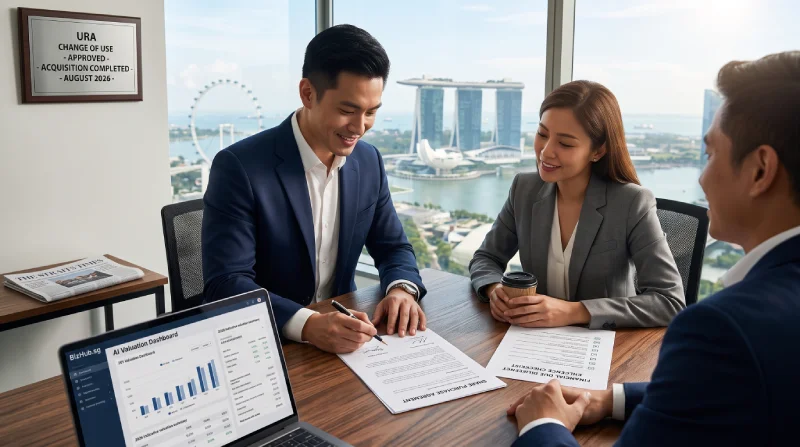
The final transaction is executed via a detailed Share Purchase Agreement (SPA) or an Asset Purchase Agreement (APA). In Singapore, this choice has significant legal and tax implications.
| Structure | Buyer Acquisition Target | Buyer Risk Profile | Key Singapore Implications |
|---|---|---|---|
| Share Sale | Entire Private Limited Company | Inherits all liabilities, historical and undisclosed. | 0.2% IRAS Stamp Duty payable on share transfer. MOM Quotas remain intact. SFA/permits usually stay active. |
| Asset Sale | Specific Assets (Equipment, Goodwill, Tenancy) | High risk mitigation. Liabilities remain with the seller. | Requires new ACRA company setup. New MOM quota applications needed. Permits (SFA Food Shop) must be reapplied for. GST might apply. |
If you are buying the corporate entity (a Private Limited Company), the statutory share transfer process is mandatory:
The closing process involves dozens of interdependent actions:
Yes. Foreign individuals can be 100% shareholders of a Singapore Private Limited Company. However, to actively manage the business within Singapore, you must apply for an Employment Pass (EP) or an EntrePass, which are subject to stringent minimum salary and investment criteria set by the Ministry of Manpower.
A straightforward acquisition typically takes 2 to 4 months. This includes 30 days for sourcing and preliminary evaluation, 30-60 days for exclusivity-backed due diligence and negotiation, and 14-21 days for the statutory ACRA and bank account closing procedures.
No. Standard marketplace listings rely on information reported directly by the seller. Independent verification of all financial statements against IRAS statutory tax filings and bank records is the sole responsibility of the buyer during the due diligence phase.
Learning how to buy a business in Singapore is only the first step. Success requires moving from theory to structured analysis. By rigorously following this eight-step roadmap-supported by modern AI valuation and due diligence frameworks-you significantly reduce the operational and financial risks inherent in an acquisition.
Instead of building from zero, you can focus on scaling an already-profitable Singapore entity.
Please wait while we prepare your results