
One of the most frequent financial oversights made by first-time acquirers in Singapore is equating the agreed purchase price with total capital requirement. A buyer who budgets solely for the negotiated valuation or takeover fee will quickly face severe cash-flow strain before completing their first quarter of commercial operations.
Executing a successful acquisition requires budgeting for statutory transaction fees, mandatory commercial lease commitments, professional conveyancing retainers, and operating capital buffers. In Singapore’s high-overhead commercial environment, these supplementary expenditures routinely add 20% to 35% on top of the headline transaction figure.
This guide provides a comprehensive capital planning framework detailing the true cost of buying a business in Singapore, ensuring you secure sufficient liquidity across every stage of the transaction.
Beyond the negotiated purchase price, buying a business in Singapore typically requires an additional 20% to 35% in supplementary capital. This ancillary budget covers five essential expenditure categories:
Securing clear legal ownership requires mandatory statutory payments to government bodies alongside professional advisory retainers to draft enforceable contracts.
Acquiring an operational Singapore company via a Share Purchase Agreement (SPA) incurs mandatory equity transfer stamp duty under the Stamp Duties Act.
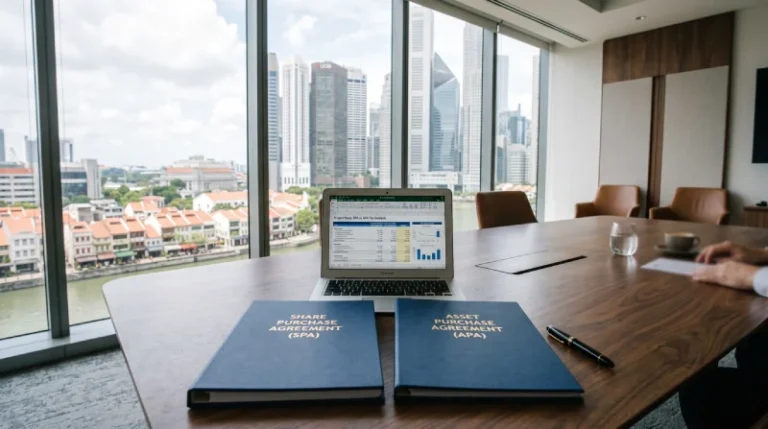
Engaging qualified corporate legal counsel is necessary to draft the Non-Disclosure Agreement (NDA), Letter of Intent (LOI), and the definitive Share Purchase Agreement (SPA) or Asset Purchase Agreement (APA).
Independent verification of the seller’s historical management accounts against IRAS tax filings and bank records prevents inheriting hidden debts.
In physical sectors such as retail, wellness, and food and beverage, securing the operational location is often the single largest upfront cash drain.
Commercial landlords across Singapore (including shopping mall operators, JTC, and private REITs) require a cash security deposit upon lease assignment.
Private commercial landlords frequently levy administrative vetting fees to assess an incoming tenant’s creditworthiness.
Opening or transferring commercial utility accounts (electricity, water, gas) with SP Group requires an institutional cash deposit based on historical consumption.
A business cannot trade without immediate operational liquidity. Under-capitalising this post-completion phase risks operational interruption during the handover.
The headline asking price for an SME rarely includes existing raw materials or retail stock.
To insulate the business against post-closing liquidity shocks, buyers should maintain an emergency cash runway equal to at least a full quarter of fixed operational costs:
To illustrate how supplementary costs compound across different transaction scales, review these structured capital projections for Singapore private acquisitions:
| Capital Expenditure Item | Small Business Takeover (S$300,000 Deal) | Mid-Sized SME Acquisition (S$1,000,000 Deal) |
|---|---|---|
| Agreed Purchase / Takeover Price | S$300,000 | S$1,000,000 |
| IRAS Share Stamp Duty (0.2%) | S$600 | S$2,000 |
| Legal Conveyancing & Contract Drafting | S$6,500 | S$18,000 |
| Financial Due Diligence & Audit | S$3,500 | S$8,000 |
| ACRA Lodgement & Corporate Secretarial | S$800 | S$1,200 |
| Commercial Lease Deposit (3–4 Months) | S$24,000 (based on S$8k/mo rent) | S$60,000 (based on S$15k/mo rent) |
| Landlord Assignment & Legal Fees | S$2,000 | S$3,500 |
| Utility Deposits (SP Group / Telecoms) | S$1,500 | S$3,500 |
| Inventory Float (Settled at Cost) | S$15,000 | S$45,000 |
| 90-Day Operating Reserve (Buffer) | S$35,000 | S$110,000 |
| Total Required Capital Outlay | S$388,900 | S$1,251,200 |
| Supplementary Capital Ratio | +29.6% above asking price | +25.1% above asking price |
If your available cash does not fully cover the total capital requirement, consider these structured financing mechanisms:
Before structuring payment terms, ensure you perform a rigorous statutory due diligence audit to verify all historical balance sheet accounts.
If the transaction is structured as a Share Sale, it is treated as an exempt financial supply and incurs 0% GST. If structured as an Asset Sale, it is subject to standard-rated GST unless it satisfies all requirements under IRAS guidelines for a Transfer of a Going Concern (TOGC).
In a Share Sale, cash retained inside the company’s bank accounts upon completion belongs to the business entity you are acquiring. However, sellers typically price deals on a “Cash-Free, Debt-Free” basis, meaning existing cash reserves are extracted via dividends prior to completion unless explicitly purchased as part of working capital adjustments.
Standard commercial practice in Singapore is to hold 10% to 20% of the total purchase consideration in an escrow account managed by a reputable law firm for a period of 6 to 12 months. This retention fund covers potential tax reassessments from IRAS, undisclosed supplier debts, or warranty claims.
Evaluating the cost of buying a business in Singapore requires looking beyond the headline purchase multiple. Factoring in statutory stamp duties, legal retainers, commercial lease commitments, and a 90-day operating cash float protects you against early liquidity constraints and positions the business for sustainable growth.
When you are ready to explore viable acquisition targets with structured financial metrics, browse profitable Singapore businesses for sale on BizHub AI to access verified listings with transparent operational and financial profiles.
Please wait while we prepare your results