
When preparing to acquire a business in Singapore, deciding on the legal structure of the transaction is just as vital as negotiating the purchase price. The mechanism you choose dictates your tax exposure, your regulatory burden, and, most importantly, whether you inherit the seller’s past legal and financial liabilities.
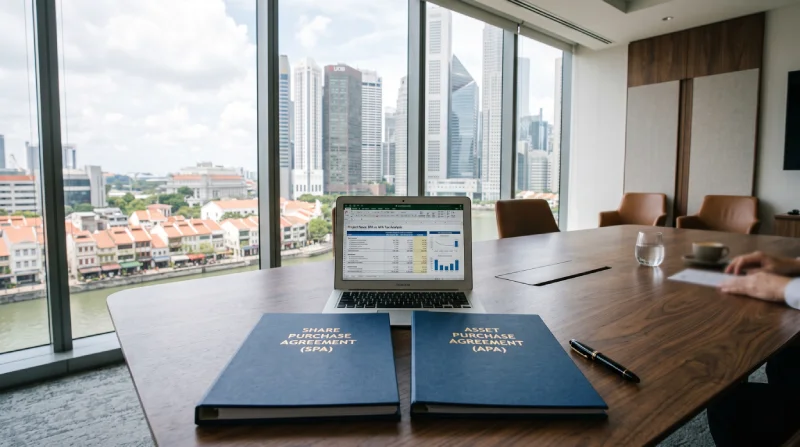
Every business acquisition fundamentally falls into one of two legal pathways: an Asset Sale (governed by an Asset Purchase Agreement, or APA) or a Share Sale (governed by a Share Purchase Agreement, or SPA). While sellers often favour a clean share disposal to offload the entire corporate entity, buyers must weigh speed and operational continuity against the risk of unrecorded liabilities.
This guide provides a rigorous, buyer-focused comparison of an asset sale vs share sale in Singapore, detailing tax treatments under the Inland Revenue Authority of Singapore (IRAS), statutory filings with the Accounting and Corporate Regulatory Authority (ACRA), and essential legal protections.
The main difference between an asset sale and a share sale in Singapore lies in what you acquire and the liabilities you inherit:
To select the appropriate vehicle, review how both deal structures function across Singapore’s legal and fiscal landscape:
| Transaction Variable | Share Sale (SPA) | Asset Sale (APA) |
|---|---|---|
| Target Acquired | 100% (or majority) equity in the existing Pte Ltd. | Selected tangible and intangible assets only. |
| Buyer Liability Exposure | High: Inherits all historical corporate liabilities and past non-compliance. | Low: Clean slate; past corporate liabilities remain with the seller. |
| Tax on Transfer (Stamp Duty) | 0.2% IRAS Stamp Duty on the consideration or Net Asset Value (NAV), whichever is higher. | 0% Stamp Duty (unless direct commercial property/immovable real estate is transferred). |
| GST Treatment | Exempt from GST (financial service transaction). | Treated as standard-rated GST unless qualifying as a Transfer of a Going Concern (TOGC). |
| Licences & Permits (e.g., SFA) | Remain valid inside the entity (subject to change-of-control rules). | Void; the buyer’s new company must apply for fresh operating licences. |
| Commercial Contracts & Leases | Retained automatically unless a “Change of Control” clause applies. | Requires formal Novation or assignment of each supplier and landlord contract. |
| MOM Foreign Worker Quotas | Preserved under the existing company Corppass account. | Lost; the buyer must build a local hiring ratio before qualifying for foreign quotas. |
| Execution Complexity | Straightforward conveyancing, but demands exhaustive due diligence. | Complex logistical assignment, but substantially simpler legal liability risk. |
A Share Sale involves purchasing the target company’s equity directly from its shareholders. In the eyes of ACRA and Singapore law, the company itself remains entirely unchanged; only its beneficial ownership transfers.
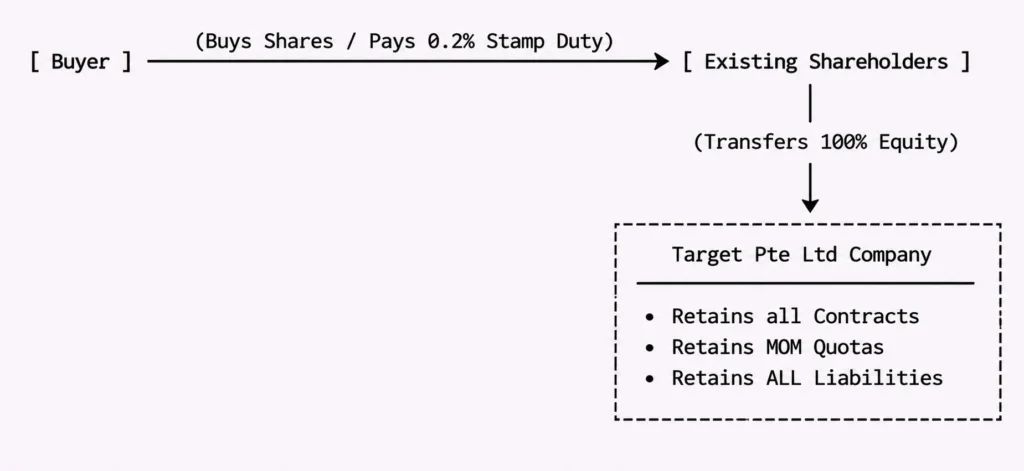
The paramount risk of a share purchase is that you inherit everything. If the previous management under-declared corporate taxes to IRAS, failed to pay mandatory Central Provident Fund (CPF) contributions for staff, or breached commercial confidentiality agreements three years prior, the company—and therefore your investment—remains liable.
To mitigate this, buyers must pair a Share Purchase Agreement with comprehensive indemnities, extensive seller warranties, and an escrow retention mechanism (typically holding back 10%–20% of the purchase price for 6 to 12 months).
Executing a Share Sale requires an Instrument of Transfer, a Directors’ Resolution in Writing (DRIW), and formal stamping.
In an Asset Sale, the buyer establishes a separate corporate entity (e.g., NewCo Pte Ltd) and uses it to “cherry-pick” the operational components of the seller’s business.
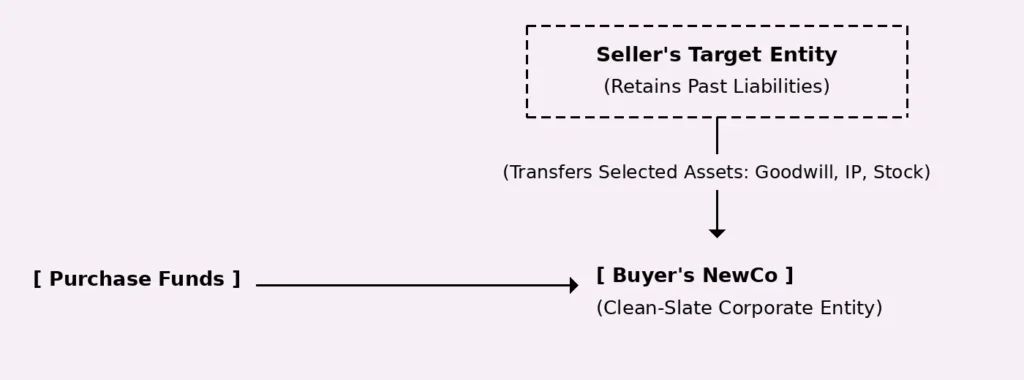
You buy the brand name, website domain, customer lists, plant and machinery, and inventory, while leaving behind the seller’s bank accounts, historical liabilities, and legal entanglements.
While an Asset Sale provides optimal legal protection, it introduces operational and tax overheads:
Because your new corporate entity is legally distinct, existing customer contracts and vendor arrangements do not transfer automatically. Each agreement must be formally novated or reassigned. Commercial landlords must review and approve your new entity, often requiring fresh 3–6 month security deposits and personal director guarantees.
Under normal circumstances, the sale of business assets by a GST-registered company attracts standard-rated GST. On a $500,000 asset acquisition, an unexpected 9% GST charge creates an immediate $45,000 cash-flow liability.
However, if structured correctly under the Inland Revenue Authority of Singapore’s Transfer of a Going Concern (TOGC) rules, the transaction is treated as an “excluded supply” and attracts 0% GST. To qualify for TOGC treatment:
Use this decision logic when evaluating an acquisition target:
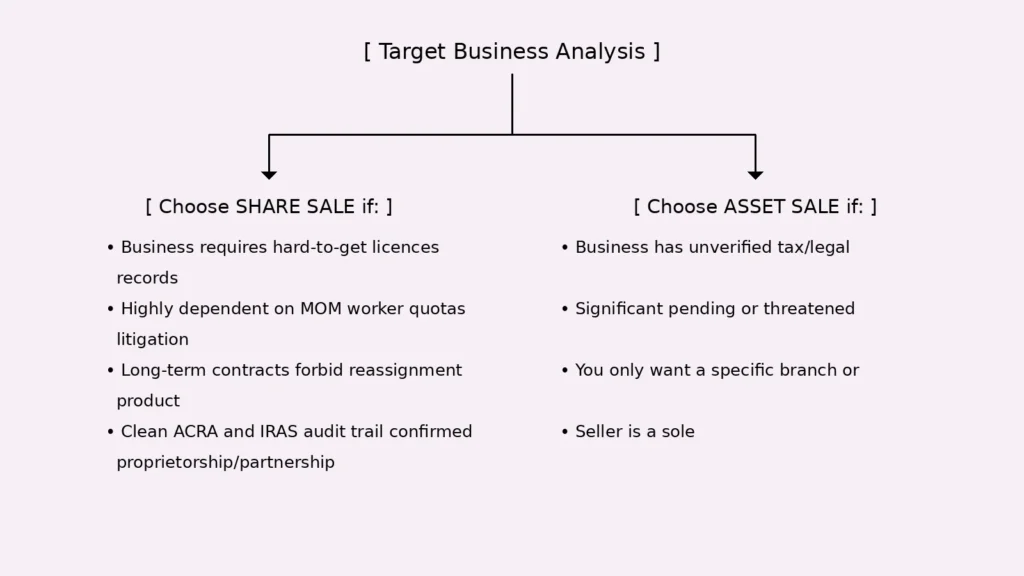
If you are pursuing a share transaction, pairing your offer with a comprehensive acquisition roadmap and strict business acquisition due diligence is essential to safeguard your capital.
No. Sole proprietorships and general partnerships do not possess separate legal personality or share capital. Transactions involving these business types are strictly executed as Asset Sales, with the buyer purchasing the business assets and name, followed by registering a new entity under ACRA.
Under standard Singapore commercial practice and the Stamp Duties Act, the buyer pays the 0.2% IRAS Stamp Duty, unless explicitly agreed and documented otherwise in the Share Purchase Agreement.
Under Section 18A of the Singapore Employment Act, when a business or undertaking is transferred from one entity to another as a going concern, the employment contracts of eligible employees automatically transfer to the new owner on terms no less favourable than before. Buyers must account for accrued annual leave and length-of-service obligations.
Determining whether to pursue an asset sale vs share sale in Singapore comes down to balancing structural simplicity against risk exposure. A Share Sale delivers turnkey speed, continuity of commercial contracts, and preserved MOM quotas, but requires extensive due diligence to protect against undisclosed corporate baggage. Conversely, an Asset Sale shields you from past liabilities at the expense of administrative novations, fresh licensing, and strict TOGC compliance.
Before formalising an offer, consult qualified corporate counsel to align your acquisition structure with the target company’s risk profile. When you are ready to evaluate opportunities, browse active businesses for sale in Singapore on BizHub AI to discover pre-screened listings with structured operational data.
Please wait while we prepare your results