
Many buyers search “buy small business in Singapore” because they want a faster route into ownership. A small business for sale may already have customers, staff, revenue, suppliers, and operating systems. However, established businesses may come with hidden problems which as buyer can only detect after a careful review.
This article seeks to identify the red flags that enlighten a buyer before they make any commitments. It is not a full legal checklist. Instead, it helps buyers slow down, question weak claims, and decide whether an opportunity deserves deeper review. The aim is to spot issues early, before valuation work, seller negotiations, or transaction documents become serious.
The seller’s reason for sale deserves early attention. Some reasons are normal, such as retirement, relocation, succession planning, or a change in personal priorities. Other reasons need more careful review, especially when the business shows falling revenue, rising costs, staff instability, or lease pressure.
Before you buy small business in Singapore, ask whether the seller’s explanation matches the records. A seller may say they are retiring, while financial performance shows sudden decline, which certainly creates an important question if not show any proof of dishonesty.
A weak or changing story is also a warning sign. If the seller gives different reasons in different conversations, proceed carefully. Consistent explanations matter when buying a small business because the buyer depends heavily on seller transparency. Buyers should also check whether the sale timeline feels unusually rushed, as pressure can reduce careful review.
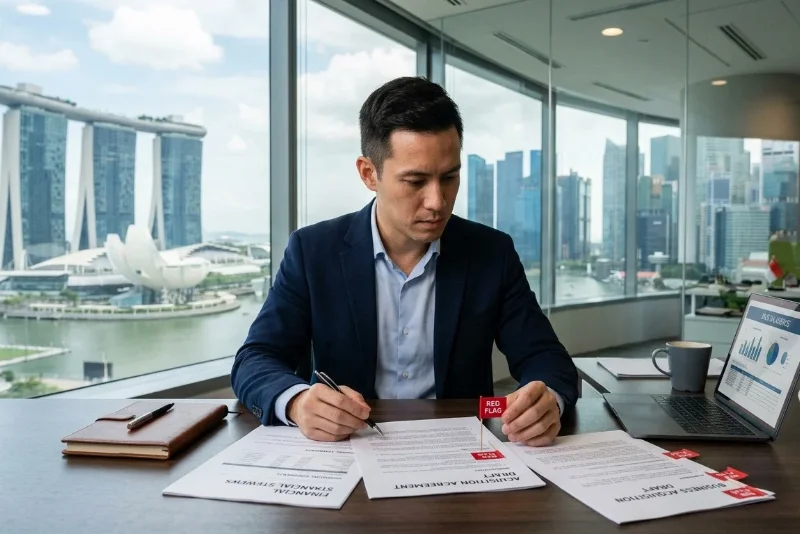
Financial records should explain the business clearly. Business financial red flags appear when figures are incomplete, inconsistent, or difficult to reconcile. Buyers should be careful when revenue is shown without profit, or when profit is claimed without supporting documents.
If you buy small business in Singapore based only on headline revenue, the risk can be high. Revenue does not show rent, wages, supplier costs, marketing costs, debt, or owner compensation. A business with strong sales can still produce weak returns.
Improvement of performance all on a sudden before sale can be a concern. Certain initiatives like discounts, promotions or flash sales may cause a revenue spike in a short time. Buyers must clarify the recent performance and try to know if it is repeatable.
Poor expense records also matter. If the seller cannot explain major costs, margins, or add-backs, valuation becomes unreliable. At that point, business due diligence should include financial statements, tax records, bank statements, invoices, and management accounts.
Buyers should also review debt, unpaid bills, deposits, refunds, and tax obligations. These items may not appear clearly in a listing. If liabilities are ignored, the real purchase cost can be higher than expected.
Operational problems can reduce the value of an otherwise attractive business with owner dependency being the most common one. If the owner handles sales, supplier relationships, staff decisions, pricing, and customer service, the buyer may struggle after takeover.
When you buy small business in Singapore, operational dependence should be reviewed before making an offer, especially an enquiry to know what the business owner does on a routine basis. Then check whether employees, systems, or documented processes can support the work after completion.
Weak systems are another warning sign. A business that runs through informal habits may be hard to transfer. Missing manuals, unclear workflows, weak reporting, and undocumented supplier processes can create handover problems.
Staff instability should also raise concern. Frequent turnover, unclear roles, unpaid obligations, or key employees planning to leave can affect continuity. These are serious business acquisition risks because small businesses often depend on a few important people.
Lease and licence issues can also weaken an acquisition. A cafe, clinic, salon, or retail outlet may depend heavily on location and regulatory approvals. If leases, permits, or landlord consent cannot transfer, the opportunity may change after completion.
Customers should be reviewed beyond total sales. A business may look stable because one or two customers provide most revenue. If those customers leave after the sale, the buyer may lose value quickly.
A buyer who plans to buy small business in Singapore should check customer concentration, repeat purchase patterns, and contract status. Informal relationships can be risky if they depend on the seller personally. This is especially important in service businesses, B2B operations, and project-based work.
Supplier dependency can create similar problems. If the business relies on one supplier, one distributor, one platform, or one landlord, continuity may be fragile. Buyers should ask whether these relationships can continue after ownership changes.
Some warning signs typically appear outside business accounts. Poor reviews, unresolved complaints, weak staff morale, unclear licences, and expiring leases can all affect future performance. In Singapore, official business information resources can support basic entity checks before deeper review.
Reputation should also be checked across public channels where relevant. The seller material may not show problems that are often visible through forum posts, customer complaints or reviews, and social pages. A weak public reputation does not always end the opportunity, but it should influence price, handover, and risk assessment.
Before you buy small business in Singapore, separate fixable issues from serious risks. A missing document may be easy to request. However, unsupported profit claims, unclear ownership, expiring leases, and heavy owner dependency need stronger investigation.
Buyers should also compare the asking price with the evidence available. A seller may ask for a premium because of reputation, location, assets, or growth potential, but the claims are best supported by records rather than confidence only.
BIZHUB or any AI-assisted platform really helps you with evaluation, but you should not immediately replace the buyer review process. They may help organise listing information, identify weak areas, or prepare questions. Still, seller claims must be verified through documents and professional advice where needed.
The safest way to buy small business in Singapore is to stay disciplined before making an offer. Look beyond the listing, question weak evidence, and review the risks that may affect transfer after completion. A good opportunity should make sense financially, operationally, and commercially.
Please wait while we prepare your results